


LSU Geologist Studies Lunar Meteorites, Can’t Wait for Artemis Observations
April 06, 2026
By studying samples collected by previous Apollo missions of lunar soil, as well as meteorites from the Moon, LSU geologist Matthew Loocke has been able to unlock new information about how the Moon formed, what it looked like in the past, and what previously unknown chemistries and critical minerals might exist there now. The Artemis missions promise to unlock heaps of new information, and he can’t wait.
Learn more from our recent Q&A chat with Loocke about lunar geology!
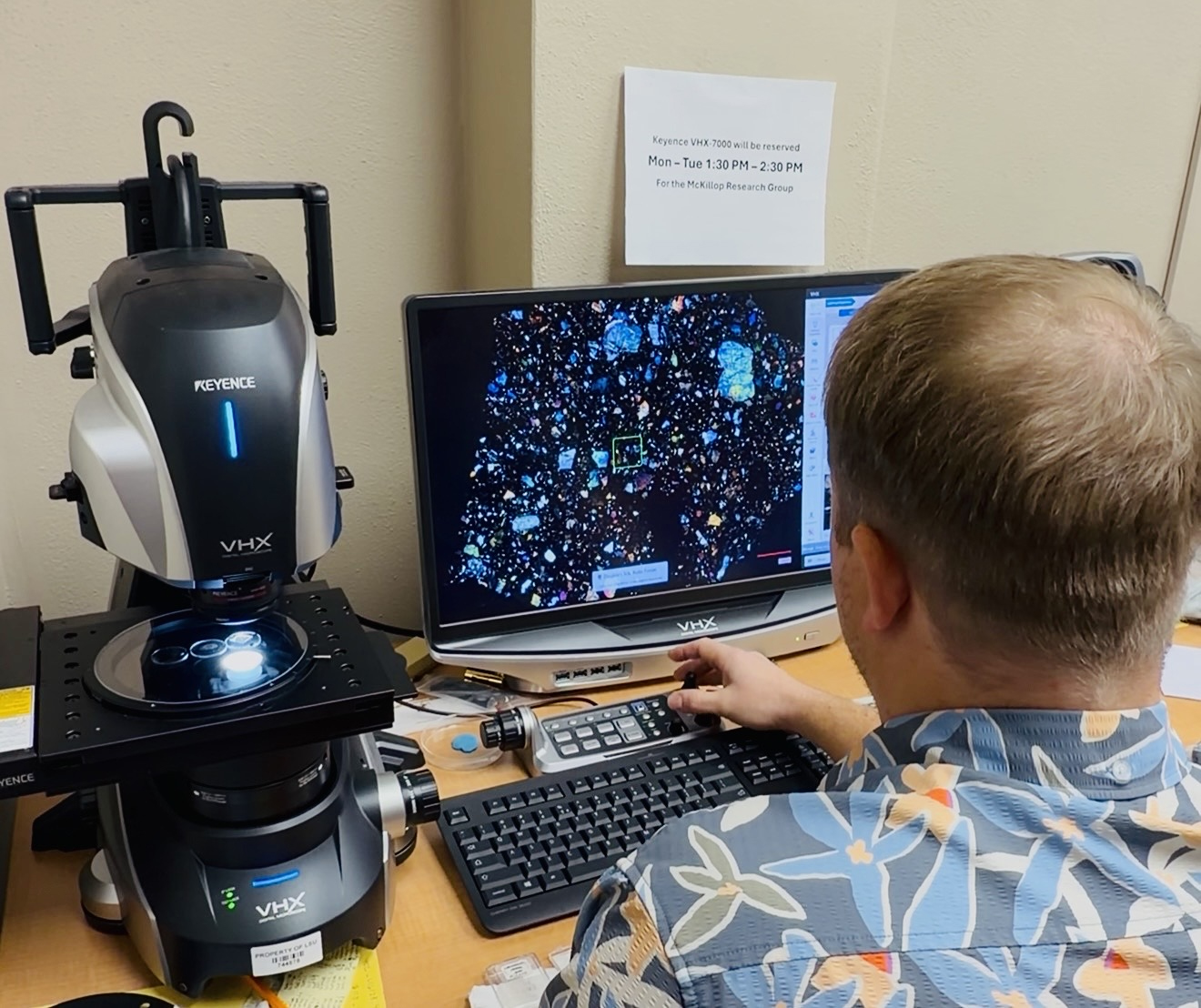
Matthew Loocke in his lab.
If we already found out a lot about the Moon through the Apollo missions, what’s the value in going back, from a geology perspective?
Where the Apollo missions landed on the Moon was one of the easiest places to land, as far as we could tell. Where we landed and collected samples is actually a somewhat unique feature compared to the rest of the Moon. As our technology has advanced and we have mapped the Moon with satellites, we are finding that the lunar materials collected and investigated by the Apollo missions are not representative of most of the Moon.
When future Artemis missions land on the Moon and collect new samples, we will finally be able to ground-truth some of our recent hypotheses and advance our scientific method.
What do we know about the geology of the rest of the Moon? (And how do we know it?)
Around 1981, we first recognized a meteorite that had landed on Earth as having come from the Moon. We knew because we could compare it with samples collected from the Moon.
As we’ve studied more and more of these lunar meteorites, we’ve found that much of the material sampled by the Apollo astronauts is very different from what we see in these meteorites. What we call lunar impact breccias are great time capsules that essentially represent a random sampling of Moon soil.
The really, really exciting thing to me about going back to the Moon, and in particular the South Pole with the Artemis missions, is… since the Apollo missions, we have just countless hypotheses that we’ve been developing to explain some of the different rock types that we’re seeing, the structures, how things formed, the distribution of materials. Physically collecting even a handful of new samples on the Moon will help us answer countless questions that we’ve had for quite a while.
And then, of course, the best thing about science is that for every question that you answer, ten new questions come up. So, the amount of science that’s going be done from this is truly mind-blowing. It gives me chills, like I have goosebumps on my arms just thinking about it.
What is a lunar impact breccia?
Every time another meteorite hits the Moon, it creates lunar rock fragments that get strewn across the lunar surface. In that process, which also involves a lot of mixing and melting, some lunar materials are ejected from the lunar surface and eventually make it down to Earth in the form of lunar impact breccia. These meteorites are a great random sample of the materials present across a broad region of the Moon. So, since we haven’t been going back and we didn’t establish a base in the seventies like we originally wanted to, this has been our best way to actually try and figure out what the rest of the Moon is made of.
But it’s a lot of effort. If you were working on some aspect of Earth geology, you would go out and collect 50 to 60 samples for a statistically robust analysis. But often, students work on just one of these meteorites for a research project because of the amount of work involved. You have to sit at the microscope for a very long time, then get on our microanalytical instrumentation and carefully analyze all the different grains and clasts to try and tease out whatever information you can about the lithologies (a rock’s physical characteristics) present.
What are the benefits of studying lunar geology?
One of the great things about studying other planetary bodies and trying to better understand them is that, in the process, we develop a better understanding of how the Earth works and where it came from. Also, you know, we need critical minerals here on Earth, and a lot of our new ideas for how to explore for those critical minerals here are helping us to look for them on other planets, and vice versa. The value of doing this kind of science, you almost can’t put a price tag on it.
Look at what NASA’s been able to achieve… we have Velcro because of NASA. There have been major technological achievements due to the work of NASA scientists and engineers, and we use many of these technologies daily.
What are some interesting things you’ve found by studying lunar samples and meteorites?
One of the things we are seeing in the lunar basalts (igneous or volcanic rocks) sampled by the Apollo missions is that they have beautiful textures and nice, big crystals. But when we examine them using our microanalytical techniques, we can clearly see chemical zoning. But not just normal chemical zoning. There are subtle pathways of other materials worming their way through these lavas that suggest a much more “juicy” process. That is direct evidence for what we call open systems rather than closed systems, meaning there is chemical exchange between these magmatic chambers and outside materials.
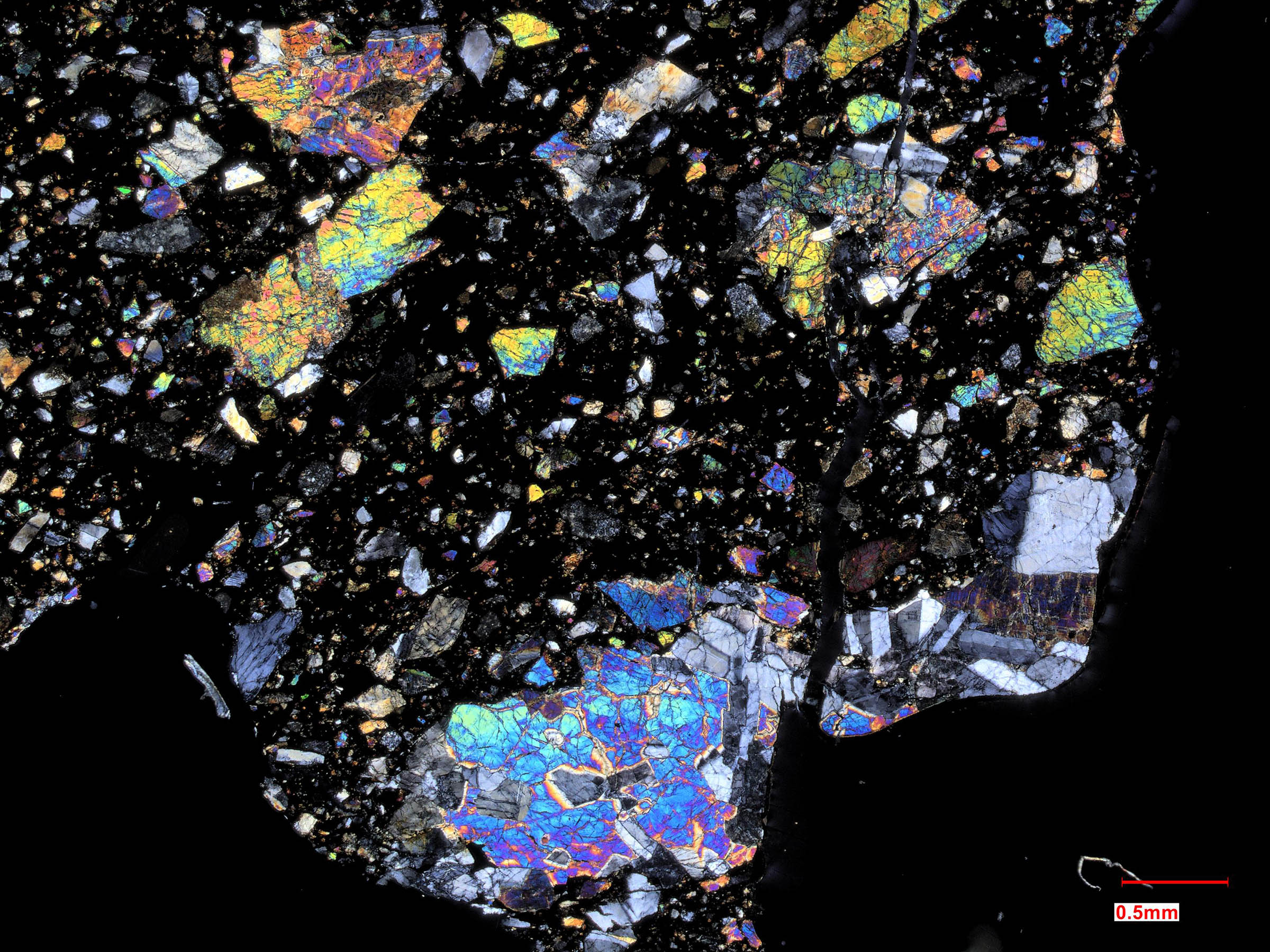
Lunar lava.
Wait – lava on the Moon?!
Oh, yes. The soil on the lunar surface is called regolith. In lunar regolith samples, we’ve actually found little glass beads. They actually can be different colors. And some of them have skeletal-looking minerals within them. This happens when you can quench, or very rapidly cool, magma as it erupts. You get these very quickly growing crystals that don’t match the normal crystal form we would expect to see otherwise. When we started finding these glass beads in lunar regolith, the only way we could explain them was that they formed from fire fountain eruptions on the Moon (millions of years ago).
These are the same kind of eruptions that happen in Hawaii, for example, where we call the type of lava they created ‘A’ā (pronounced "ah-ah") lava, because it’s very sharp and glassy, right? It would hurt to walk on.
Everybody looks at the Moon and goes, ‘Oh, it’s gray.’ Well, actually, it’s not just gray. There are subtle differences in color in the lunar soil, hues of red and green, coming from these glass beads. The different colors also reflect different chemistries. Scientists have actually been studying these chemistries by using satellites orbiting the Moon that map the lunar surface and use the properties of light reflected off the surface to determine what kind of material is there.
My lab at LSU specializes in lunar minerals called the Spinel Group Minerals. We’ve found pink spinel, which contains magnesium along with aluminum and oxygen. They are pink, and we started finding them in some of the meteorites from the Moon.
How can you tell that a particular rock comes from the Moon instead of Earth?
Some of the best geologists can do an enormous amount of research with just a cross-polarizing microscope and a meteorite sample by examining fragments within it and their color, texture, and other physical characteristics. We can compare what we see in meteorite samples to rocks on Earth.
Some people think we haven’t landed on the Moon. But I can tell you that the rocks we get from the Moon, while they may look similar to those from Earth, have very distinct characteristics. They have different abundances of titanium and iron, at ratios that differ from those we tend to get on Earth. Every planetary body has very characteristic chemistries, even different isotopes of oxygen, for example, that go back to how the solar system formed.
Yeah. My favorite days are the ones when I get to come and sit in here at the microscope.
What are you most excited about for the future of lunar geology research?
By studying lunar volcanic rocks collected by the Apollo missions, my lab has found evidence that some minerals in these samples were transported through complex magmatic systems akin to those at mid-ocean ridges on Earth. With every new Lunar mission, we make new observations that deepen our understanding of the Moon and its history. The Artemis missions have the potential to push our understanding of the Moon forward by leaps and bounds. I am particularly excited just thinking about the countless hypotheses proposed since the Apollo missions that we will finally be able to test, thanks to the Artemis missions.
Discover stories showcasing LSU’s academic excellence, innovation, culture, and impact
across Louisiana.Next Step